
Sliding doors are one of the most used features in any Dallas home. They connect living rooms to patios, bedrooms to balconies, and kitchens to outdoor entertaining spaces. But when a sliding door starts sticking, grinding, or letting in drafts, it stops being a convenience and starts being a problem. The good news? Most sliding door issues are fixable – and fixing them promptly protects your home’s security, comfort, and energy efficiency.
This guide covers everything a Dallas homeowner needs to know about residential sliding door repair: the warning signs to watch for, the components most likely to fail, what repairs actually cost, and when to call a professional instead of reaching for the toolbox.
Warning Signs Your Sliding Door Needs Attention
The most expensive repairs are usually the ones that were ignored too long. Sliding doors rarely fail without warning – they almost always give you signals first. Catching those signals early is the difference between a quick, affordable fix and a full door replacement.
Unusual noises are often the first indicator. If your sliding door emits grinding or scraping sounds when you open or close it, the rollers are likely worn down or the door is rubbing against the frame. That metal-on-metal contact accelerates wear on every component it touches, so the longer you wait, the more damage accumulates.
Resistance or stiffness is another clear sign. A properly functioning sliding door should glide open with minimal effort. If you find yourself putting your shoulder into it, something is wrong – whether that’s debris packed into the track, misaligned rollers, or a bent frame.
Drafts and temperature inconsistencies near the door point to failed weatherstripping or a door that no longer sits flush in its frame. According to the U.S. Environmental Protection Agency, air leakage accounts for 25% to 40% of the energy used for heating and cooling in a typical residence [1]. In a Dallas summer, a leaky sliding door can meaningfully increase your cooling costs.
Visible gaps or misalignment – where the door panel no longer sits evenly in the frame – indicate roller failure or track damage. If you can see daylight around the edges of a closed door, the seal has failed.
Foggy or condensation-filled glass between double-pane panels signals a broken seal in the insulated glass unit. This is a separate issue from the door’s mechanical operation, but it significantly reduces the door’s insulating performance.
The Anatomy of a Sliding Door: What Can Be Repaired
Understanding the components of your sliding door helps you have more informed conversations with repair technicians and set realistic expectations about what a repair will involve.
Rollers
Rollers are the small wheel assemblies mounted at the bottom (and sometimes top) of the sliding panel. They carry the full weight of the door and allow it to glide along the track. Most residential sliding doors feature adjustment screws on the rollers – typically accessible through small holes in the door’s bottom edge or side stile. Turning these screws clockwise raises the door; counterclockwise lowers it. This adjustment can resolve minor alignment issues and help the door seal more tightly against the weatherstripping.
The Fenestration and Glazing Industry Alliance (FGIA) maintains AAMA 906-21, the active industry specification covering roller assemblies for sliding doors, which includes standards for roller assemblies with and without height adjustment features [2]. When rollers wear beyond adjustment, they need to be replaced entirely. This is one of the most common residential sliding door repairs.
Tracks
The track is the channel along which the door slides. Bottom tracks are exposed to foot traffic, dirt, pet hair, and moisture – all of which cause wear over time. A bent or corroded track prevents the rollers from moving smoothly and can cause the door to jump off its path. Cleaning a dirty track is a DIY-friendly task; replacing a damaged one typically requires professional tools and expertise.
Weatherstripping
Weatherstripping creates the seal between the moving door panel and the stationary frame. For sliding glass doors, fin seal weatherstripping – a pile strip with a plastic Mylar fin centered in the pile – is one of the most durable options available, according to the U.S. Department of Energy [3]. When weatherstripping wears down, air infiltration increases, and so does your energy bill. Replacing it is a relatively straightforward repair that has an immediate impact on comfort and efficiency.
Locks and Handles
Sliding door locks and handles take significant daily wear. Common issues include loose or stripped screws, misaligned strike plates (the metal plate the latch engages with), and broken internal locking mechanisms. A door that does not latch securely is a security risk, and this repair should be prioritized. Handle replacement is typically a simple job; replacing a mortise lock (the internal locking mechanism) requires more disassembly.
Frames and Glass
Aluminum and vinyl frames can warp or corrode over time, particularly in climates with significant temperature swings – which Dallas certainly experiences. A warped frame causes misalignment that no amount of roller adjustment can fully correct. Glass panels, whether single-pane or insulated double-pane, can crack, chip, or lose their seal. Glass replacement is one of the more involved repairs and almost always requires a professional.
Types of Residential Sliding Doors
Not all sliding doors are built the same way, and the repair approach varies by type. Here is a quick overview of the most common residential configurations:
| Door Type | How It Works | Common Repair Issues |
|---|---|---|
| Patio Sliding Glass Door | One fixed panel, one sliding panel on a bottom track | Worn rollers, dirty tracks, failed weatherstripping |
| Pocket Door | Panel slides into a wall cavity | Roller and track issues inside the wall; requires trim removal |
| Bifold Sliding Door | Multiple panels fold accordion-style | Hinge alignment, top and bottom pivot hardware |
| Atrium Door | French-door aesthetic on a sliding track | Hardware-specific roller and lock issues |
| Closet Sliding Door | Lightweight panels on top-hung or bottom-track systems | Bent tracks or dislodged top guides |
| Multi-Panel Stacking Door | Multiple panels stack behind one another | Complex track alignment across multiple panels |
Knowing which type of door you have is the first step toward an accurate repair diagnosis. Repairing an atrium sliding door, for example, requires attention to the specific hardware used by the manufacturer, which differs from a standard patio door.
DIY vs. Professional Repair: Knowing the Difference
Some sliding door maintenance tasks are genuinely homeowner-friendly. Others are not – and attempting them without the right tools or experience can make the problem worse.
Tasks that are reasonable for most homeowners:
- Cleaning the track with a vacuum and damp cloth
- Applying a silicone-based lubricant to the track and rollers
- Tightening loose screws on handles and strike plates
- Using the adjustment screws to make minor roller height corrections
Tasks that typically require a professional:
- Replacing worn or broken rollers (especially on heavy glass doors)
- Repairing or replacing a bent or corroded track
- Replacing broken or failed weatherstripping on the full door perimeter
- Repairing or replacing locks and internal locking mechanisms
- Replacing cracked or fogged glass panels
- Correcting frame warping or structural misalignment
The reason professional help matters for the complex tasks comes down to weight and precision. A standard residential sliding glass door panel can weigh between 50 and 150 pounds. Removing and reinstalling it safely requires two people and the right lifting technique. Mishandling a heavy glass panel risks injury and glass breakage – an outcome far more expensive than the original repair.
There is also the question of diagnosis. A door that sticks might have worn rollers, a dirty track, a warped frame, or all three. A professional technician can identify the actual root cause rather than addressing symptoms one at a time. This saves time and money in the long run.
Repair Costs: What to Expect in Dallas
Repair costs vary based on the type of repair, the door’s material and size, and the specific components involved. The table below provides realistic estimates for the most common residential sliding door repairs:
| Repair Type | Estimated Cost Range | Typical Timeframe |
|---|---|---|
| Track Cleaning and Lubrication | $50 – $100 | Under 1 hour |
| Roller Adjustment | $75 – $150 | Under 1 hour |
| Roller Replacement | $150 – $350 | 1 – 3 hours |
| Track Repair or Replacement | $100 – $300 | 1 – 2 hours |
| Weatherstripping Replacement | $100 – $250 | 1 – 2 hours |
| Lock or Handle Replacement | $75 – $200 | 1 hour |
| Glass Panel Replacement | $200 – $800+ | 3 – 4 hours |
| Full Door Realignment | $150 – $400 | 2 – 3 hours |
Most standard repairs – roller replacement, lock repair, weatherstripping – can be completed in a single visit of one to three hours. This matters for busy homeowners who cannot afford to take a full day off work to wait for a contractor.
It is worth noting that deferring repairs almost always increases costs. A $150 roller adjustment that goes unaddressed can lead to a $300 track replacement when the worn roller damages the track surface. Addressing issues early is the more economical path.
How to Adjust Your Sliding Door Rollers
If your door is slightly misaligned but the rollers are not yet worn out, adjusting the roller height is a reasonable first step. Here is how the process works on most standard residential sliding doors:
- Locate the adjustment screw access holes. On most patio doors, these are small holes at the bottom corners of the door panel, accessible from the interior side.
- Use a Phillips-head screwdriver to turn the adjustment screw. Clockwise raises the door; counterclockwise lowers it.
- Make small adjustments – a quarter turn at a time – and test the door’s operation after each adjustment.
- Check that the door closes flush against the weatherstripping on all sides and that the latch engages cleanly.
If the door still sticks or does not seal properly after adjustment, the rollers themselves may be worn and need replacement. Learning how to repair wheels on a sliding door goes beyond adjustment – it involves removing the door panel, extracting the old roller cartridges, and installing new ones that match the door’s manufacturer specifications.
Energy Efficiency and Your Sliding Doors
Sliding glass doors present a unique energy challenge. The U.S. Department of Energy notes that single-pane glass doors lose significantly more heat than other door types because glass is a poor insulator [3]. Even modern double-pane doors lose efficiency when their weatherstripping fails or when the glass seal breaks.
The National Fenestration Rating Council (NFRC) provides energy performance ratings for doors and windows, including U-factor (heat transfer rate) and air leakage ratings [4]. A lower U-factor means better insulating performance. When evaluating whether to repair or replace an aging sliding door, checking the NFRC rating of the current door against modern standards can inform the decision.
For Dallas homeowners, where summer cooling costs are a significant budget item, maintaining tight weatherstripping and well-adjusted rollers on sliding doors is a practical energy-saving measure. A door that seals properly keeps conditioned air inside and reduces the load on your HVAC system.
When Repair Makes More Sense Than Replacement
Not every sliding door problem requires a full replacement. Repair is typically the right choice when the door’s frame is structurally sound and not warped, the glass is intact and the insulated glass seal has not failed, the issue is limited to rollers, tracks, weatherstripping, or hardware, and the door is less than 15 to 20 years old.
Replacement becomes the better option when the frame is significantly warped or corroded, when the glass seal has failed across multiple panels, or when the door’s design is so outdated that replacement parts are no longer available. A qualified technician can assess your specific situation and give you an honest recommendation. The goal is always to find the most cost-effective solution that delivers long-term reliability – not to upsell you on a replacement you do not need.
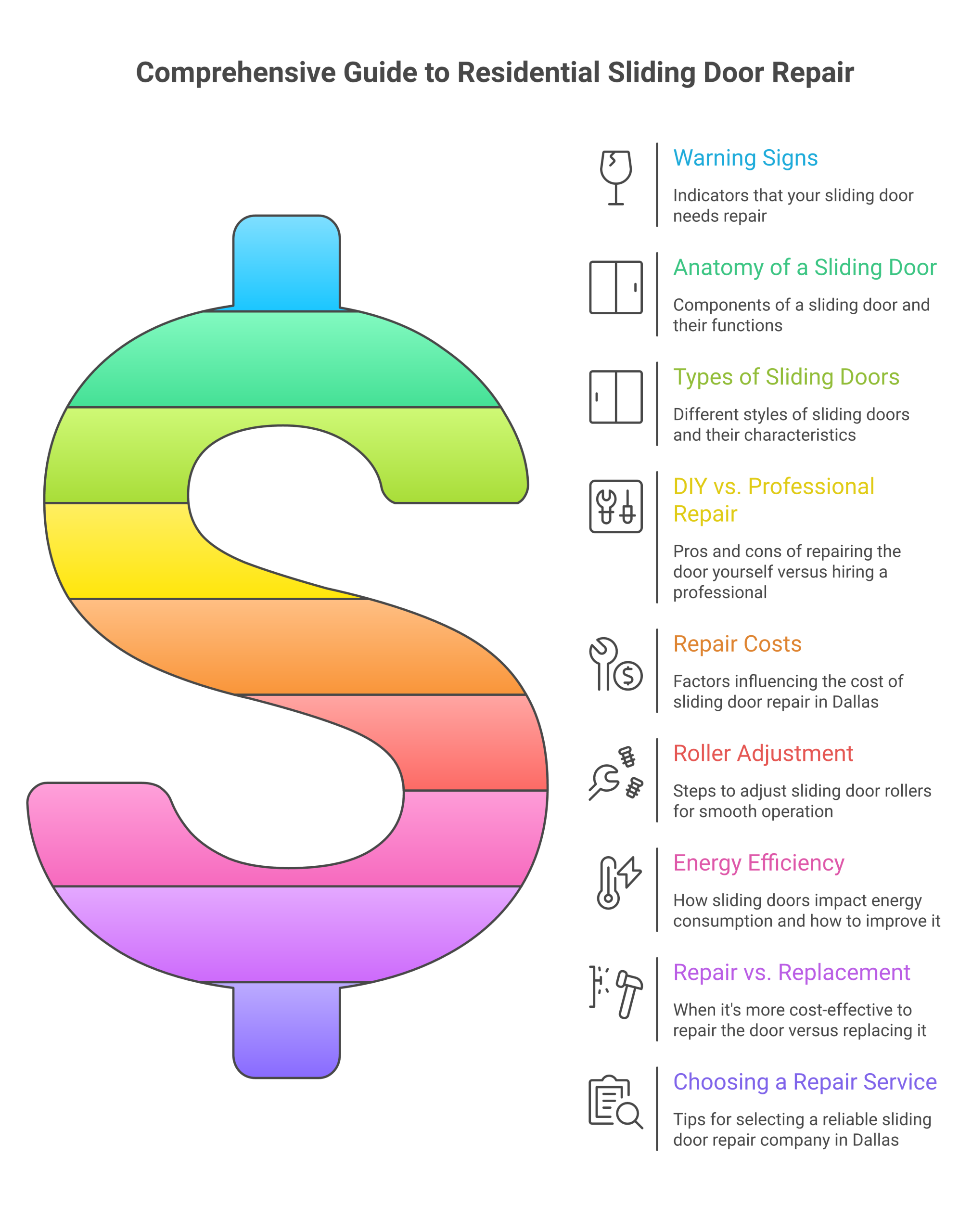
Choosing a Reliable Sliding Door Repair Service in Dallas
With so many contractors available in the Dallas area, finding one you can trust takes a bit of due diligence. Look for a warranty on labor and parts – a company that stands behind its work will offer a written guarantee, and that is the clearest signal of confidence in their own quality. You should also expect transparent pricing, with a clear estimate before any work begins and no surprise charges at the end.
Prompt scheduling matters too. A reliable service provider respects your time and shows up when they say they will. Ask about experience with your specific door type – not all technicians are equally familiar with pocket doors, bifold systems, or specialty atrium doors. Finally, look for a one-stop service that handles everything from roller replacement to glass repair to lock service, eliminating the hassle of coordinating multiple contractors.
Your sliding doors are an investment in your home’s comfort, security, and value. They deserve the same level of care and professionalism you would apply to any other major home system. If your doors are grinding, sticking, or letting in drafts, the right next step is a professional inspection – before a manageable repair becomes a costly replacement.
Select Sliding Doors serves homeowners and commercial property owners across the Dallas, TX area with fast, reliable, and fully guaranteed sliding door and window repair and installation services. Our work is backed by a 10-year warranty, so you can trust that the fix will last. If it slides, we fix it – contact us today to schedule your repair.
Sources
- Air Sealing – ENERGY STAR Fact Sheet (EPA) — Air leakage accounts for 25% to 40% of the energy used for heating and cooling in a typical residence.
- AAMA 906-21 – Specification for Sliding Door and Lift and Slide Roller Assemblies (FGIA) — Industry specification covering roller assemblies for sliding doors, including those with height adjustment features.
- Doors | Department of Energy — Single-pane glass doors lose significantly more heat than other door types; weatherstripping reduces energy losses from air leakage.
- Energy Performance Ratings for Windows, Doors, and Skylights | Department of Energy — NFRC provides U-factor and air leakage ratings for doors and windows to help homeowners compare energy performance.
- Weatherstripping | Department of Energy — Fin seal weatherstripping is recommended for sliding glass doors as one of the most durable weatherstripping options.