When a commercial sliding glass door fails, it is not just an inconvenience; it is a direct threat to your bottom line, security, and tenant satisfaction. For commercial property owners and operations managers in the Dallas area, maintaining smooth, reliable entryways is a critical operational priority. Whether you manage a bustling tech firm in Preston Hollow, a high-traffic retail storefront in Uptown, or a sprawling commercial portfolio in Plano, understanding the mechanics, costs, and compliance requirements of commercial sliding doors empowers you to make smart maintenance decisions.
At Select Sliding Doors, we know that downtime costs money. If it’s a door or a window (and it slides) – We Can Will FIX IT! This guide covers everything you need to know about commercial sliding door repair, from diagnosing common issues to understanding ADA compliance and the true cost of deferred maintenance.
The Financial Impact of Deferred Door Maintenance
Ignoring minor door issues might seem like a way to save money in the short term, but it almost always leads to higher repair expenses and operational headaches. Small problems, such as a sticking roller or a minor draft, place additional strain on the door’s mechanical components.
Repairs typically cost a fraction of a full replacement when addressed early. However, when minor issues escalate into structural failures, the costs multiply. Furthermore, damaged doors contribute significantly to energy loss. According to the U.S. Department of Energy, drafty doors and windows can increase energy costs by up to 25 percent [1]. When air escapes through gaps in a misaligned commercial door, your HVAC system must work overtime to compensate, driving up utility bills across your properties. For efficient property management, catching these issues early is essential to maintaining tenant satisfaction and minimizing maintenance expenses.
Types of Commercial Sliding Doors and Common Issues
Commercial sliding doors are subjected to significantly higher usage than residential doors, requiring specialized hardware and maintenance approaches. The most common types include:
- Automatic Sliding Doors: Frequently found in retail environments, hospitals, and large office buildings, these doors rely on complex sensor systems and motorized operators. Common issues include sensor misalignment, debris blocking the tracks, and motor wear.
- Manual Storefront Doors: These heavy-duty glass doors are standard for boutique shops and office partitions. They often suffer from worn rollers, damaged tracks, and alignment issues due to constant manual operation.
- Heavy-Duty Industrial Sliders: Used in warehouses and loading areas, these doors must withstand extreme conditions. Problems often involve track damage from heavy equipment or structural shifting.
Diagnosing Roller and Track Problems
One of the most frequent questions we hear from property managers is: “What’s the most efficient way to get a misaligned patio roller door repaired quickly and reliably without hassle?” The answer begins with understanding the track and roller system.
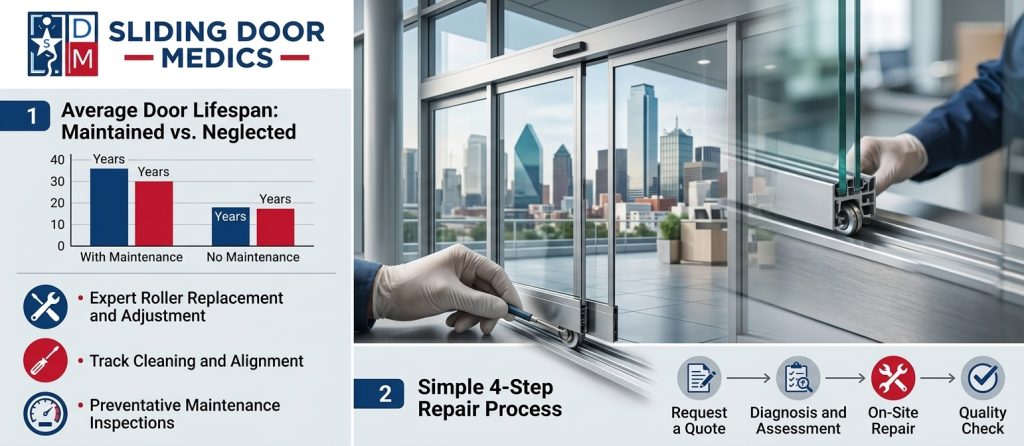
Commercial doors use heavy-duty tandem rollers to support the weight of large glass panes. Over time, dirt, grit, and lack of lubrication cause these rollers to degrade. You might notice the door becoming difficult to open, grinding noises, or the door physically dropping within its frame. Many commercial sliding doors feature adjustment screws located at the bottom edge of the door panel. Are adjustment screws standard on commercial sliding doors? Yes, they are a common and reliable feature across different sliding door types, enabling maintenance teams to quickly resolve minor alignment issues. However, if adjusting the screws does not lift the door or smooth its operation, the rollers likely need professional replacement.
For a deep dive into alignment techniques, you can read more about how to adjust patio door mechanisms on our website.
ADA Compliance and Building Codes in Dallas, TX
For commercial properties, sliding doors must meet strict accessibility and safety standards. Non-compliance not only risks legal action but also limits access for customers and employees.
ADA Accessibility Standards
The Americans with Disabilities Act (ADA) sets specific requirements for commercial entrances. According to the 2010 ADA Standards for Accessible Design, accessible doors must provide a minimum clear width of 32 inches when the door is fully open [2]. This clear width is measured from the face of the door to the opposite stop.
Additionally, the operating hardware (handles, pulls, latches) must be usable with one hand and not require tight grasping, pinching, or twisting of the wrist. The operable parts must be located between 34 inches and 48 inches above the finished floor [2]. For manual sliding doors, the force required to open the door should generally not exceed 5 pounds, ensuring that individuals with varying physical abilities can navigate the entryway safely.
Texas Building Code and Safety Glazing
In Dallas, commercial buildings must adhere to the International Building Code (IBC) as adopted and amended by the state. Chapter 24 of the IBC strictly regulates glass and glazing in hazardous locations, which includes all fixed and operable panels of sliding doors [3].
Glass used in commercial sliding doors must be safety glazing (such as tempered or laminated glass) designed to withstand impact without shattering into dangerous shards. This is critical for high-traffic areas where the risk of human impact is elevated. Ensuring your doors meet these safety standards is a non-negotiable aspect of commercial property management.
Preventative Maintenance: The Key to ROI
Commercial property owners focused on maximizing ROI know that preventative maintenance is far more cost-effective than emergency repairs. What are the best practices for routine inspection and adjustment of sliding patio door rollers across commercial properties?
- Regular Cleaning: The track must be kept free of debris. Vacuuming the bottom track weekly and wiping it down with a damp cloth prevents grit from destroying the rollers.
- Lubrication: Apply a silicone-based lubricant to the tracks and rollers periodically. Avoid petroleum-based products, which attract dirt and create a sticky residue.
- Scheduled Inspections: Implement a bi-annual inspection schedule to check weatherstripping, test sensor functionality on automatic doors, and verify alignment.
Data shows that businesses can cut automatic door repair costs by 25% or more by implementing a regular service contract [4]. Preventative maintenance minimizes downtime, extends the life of your equipment, and ensures that when a tenant calls about a stuck door, you already have a reliable partner ready to deploy.
Specialized Repair Services for Dallas Businesses
At Select Sliding Doors, we provide comprehensive solutions tailored to the unique needs of Dallas commercial properties. Whether you need an emergency fix for a dropped storefront door or routine maintenance across a portfolio of office buildings, our team delivers efficiency and speed.
We specialize in:
- Heavy-Duty Roller Replacement: Upgrading worn components with commercial-grade stainless steel or precision-bearing rollers.
- Track Resurfacing and Replacement: Repairing damaged tracks to restore smooth, effortless operation.
- Security and Lock Repairs: Ensuring your commercial locks and latches function perfectly to protect your assets.
- Specialty Services: Including comprehensive closet sliding door repair for multi-family residential units and office interiors.
If you are dealing with a complex issue and need professional insight, explore our sliding glass door repair resources for more detailed troubleshooting guides.
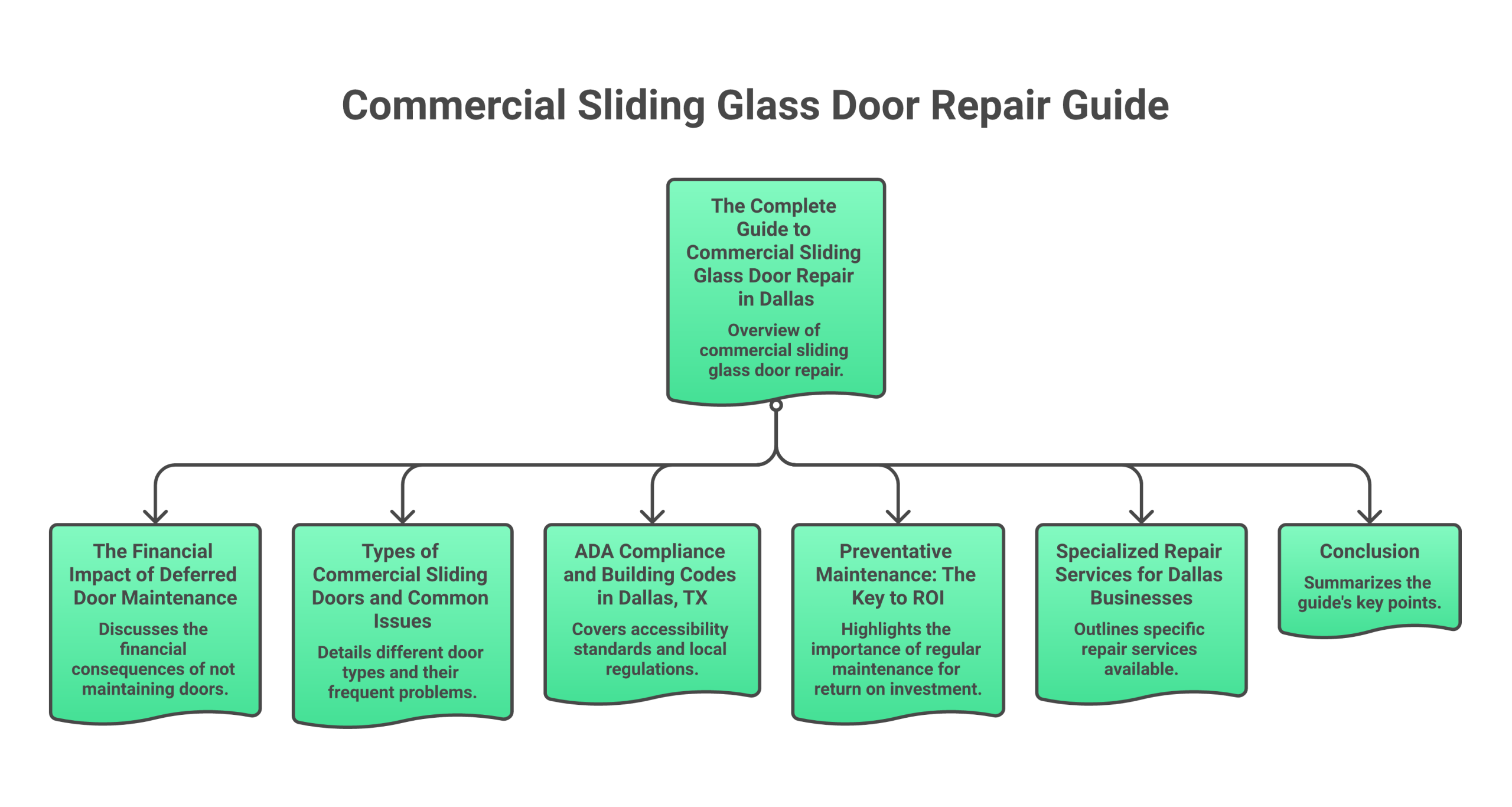
Conclusion
Maintaining the commercial sliding doors across your Dallas properties is vital for security, energy efficiency, and tenant satisfaction. By understanding the mechanics of your doors, adhering to ADA and IBC compliance standards, and prioritizing preventative maintenance, you can avoid costly emergency repairs and minimize business disruptions.
Don’t let a malfunctioning door impact your operations. If you need immediate assistance or want to establish a reliable maintenance plan, contact Select Sliding Doors today. We offer a 10-year warranty on our work, ensuring that a sliding door repair from our team is a long-term investment in your property’s success. Slide into the future with us!
Sources
- The Real Cost of Ignoring Door Repair. Why Acting Now Saves Money — Drafty doors and windows can increase energy costs by up to 25 percent.
- 2010 ADA Standards for Accessible Design — Accessible doors must provide a minimum clear width of 32 inches and operable parts must be located between 34 and 48 inches above the floor.
- Chapter 24 Glass and Glazing: Texas IHB Building Code 2021 — Regulations regarding safety glazing requirements for glass in hazardous locations including sliding doors.
- Data Shows Service Contracts for Automated Doors Can Save Your Business 25% or More — Businesses can cut automatic door repair costs by 25% or more with a service contract.